I have experience with writing for video, website blogs, website pages, and social media posts.
SEO-Optimized Web Writing
During my time at Baystate Health, I have written articles for internal communications, the external website, and newsletters. While writing these articles, I made a particular effort to create rich content that followed best SEO practices.
One of the article I’d written during the pandemic, Why you shouldn’t wear gloves to the grocery store, was hyperlinked in a newsletter and had a 70% open rate.
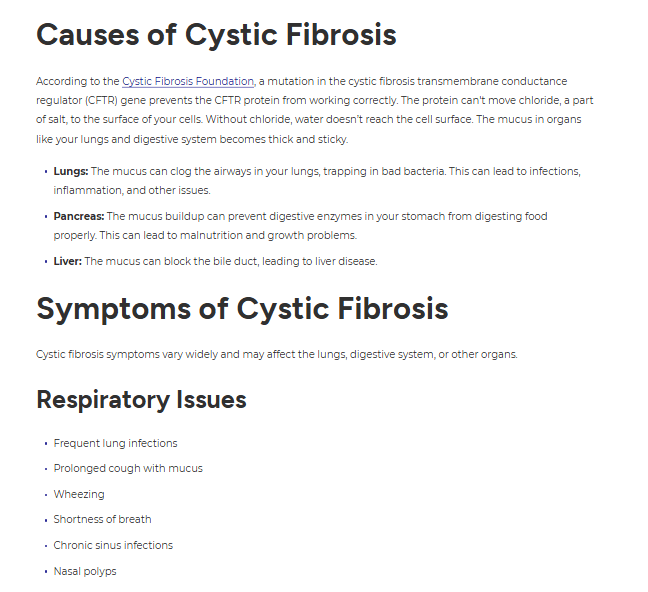
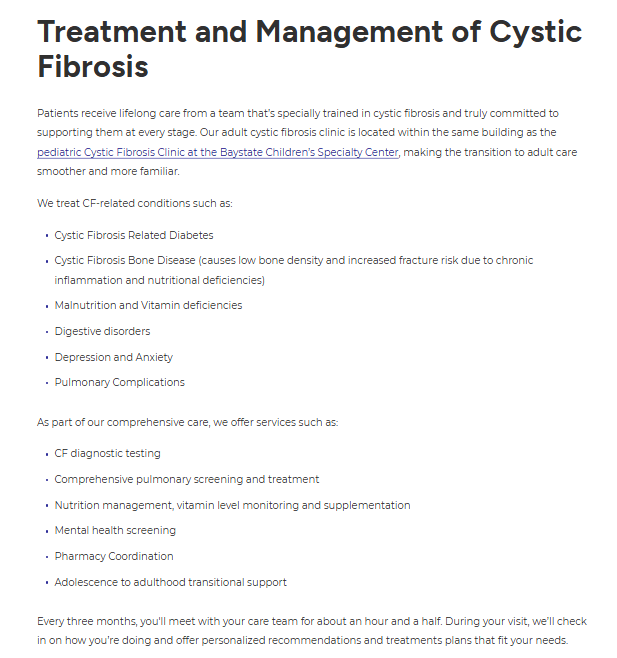
I created the content for Baystate Health’s Cystic Fibrosis medical services page, making sure to translate complex medical information into plain English, include key SEO terms, and incorporate healthful web components and crosslinks.



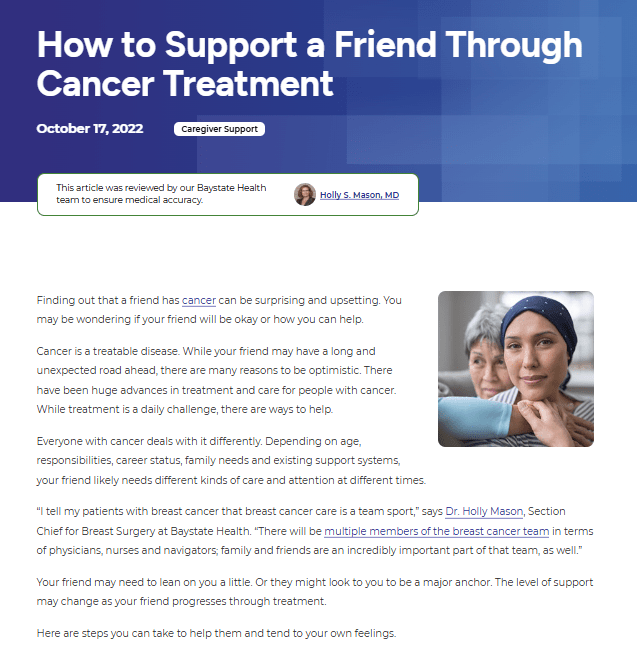
Finding out that a friend has cancer can be surprising and upsetting. You may be wondering if your friend will be okay or how you can help.
Cancer is a treatable disease. While your friend may have a long and unexpected road ahead, there are many reasons to be optimistic. There have been huge advances in treatment and care for people with cancer. While treatment is a daily challenge, there are ways to help.
Everyone with cancer deals with it differently. Depending on age, responsibilities, career status, family needs and existing support systems, your friend likely needs different kinds of care and attention at different times.
“I tell my patients with breast cancer that breast cancer care is a team sport,” says Dr. Holly Mason, Section Chief for Breast Surgery at Baystate Health. “There will be multiple members of the breast cancer team in terms of physicians, nurses and navigators; family and friends are an incredibly important part of that team, as well.”
Your friend may need to lean on you a little. Or they might look to you to be a major anchor. The level of support may change as your friend progresses through treatment.
Here are steps you can take to help them and tend to your own feelings.
How to cheer up your loved one
Every person is unique, so cheering someone up isn’t one-size-fits-all.
You can try:
- Calling or texting: A cancer diagnosis can be isolating. Your friend may appreciate you reaching out.
- Visiting in person or through video chat: Ask ahead of time so you know they’re available, schedule-wise and emotionally.
- Volunteer to help: Whether you’re their point person or just available for certain tasks, offering your time can really take the burden off your friend.
- Bringing over a thoughtful gift: Show your loved one you care with a little something special.
Keep in mind, you may not be able to cheer your friend up. But it’s important to make an effort.
What can you say to a loved one with cancer?
Reassure without promises
No one knows the future. Be supportive by saying something like, “I’m here for you, and I will continue to be here for you, no matter what.” Promising it will all be okay may ring false to your friend. Knowing they can count on your support will give them additional strength.
Check in but don’t push
Doctors often tout the benefits of minimally invasive surgery methods. A text or email is a minimally invasive communication method. It lets your friend know you’re thinking of them without pressuring them to reply.
Check in on your friend regularly. You can say something like, “You don’t need to respond. Just wanted to let you know I’m thinking about you.”
Know what not to say
There are a lot of things you shouldn’t say to someone with cancer.
Have some empathy and use your judgement. You don’t want to rub their diagnosis in their face, gloss over their situation, force them to think about their chances of survival, or compare suffering.
The New York Times outlines some examples of bad phrasing and topics to bring up, including:
- “It will be okay.”
- “I know how you feel.”
- “I have another friend with cancer who died.”
- “You should be happy you have this type of cancer instead of this other worse cancer.”
- “You probably got cancer because of your smoking habit.”
- “I heard about this unproven experimental treatment that might work on you.”
Don’t make yourself an additional sore spot in your loved one’s life by making inconsiderate comments.
How do you help a loved one with cancer?
It can be confusing to know what to do when a friend or family member has cancer. If you are going to help out, you want to make sure you’re not inadvertently adding to their troubles.
Find or become the captain
Your friend is juggling appointments, concerns about family and other demands. They may be overwhelmed by a barrage of well-meaning messages. They also don’t want to end up with ten full sized lasagnas in the fridge because friends didn’t coordinate.
Find a main point of contact they can rely on — or become that person. Funnel all offers of help through the “captain,” who communicates to the group about your friend’s needs and wants.
Be specific
Many people offer to help but a person dealing with the challenges of cancer treatment can’t always tell you exactly what they need. Remove the burden of yet another decision or choice by being as specific as possible with your offers:
- “I’m bringing pizza on Friday night. Is there a particular place your family likes?”
- “I’ll drive your carpool on Mondays and Thursdays.”
- “Would your daughter like to come over to play on Sunday morning?”
Help them find a support system
A friend with cancer is still your friend. While they may be dealing with a challenge, they still want you by their side. Provide hope by creating and taking part in a support system that encourages your friend to focus on healing.
Seek out support groups. Here are some in-person and virtual options in western Massachusetts:
What can you get a loved one with cancer?
If your friend is facing chemotherapy or surgery, consider purchasing things they may need. A small, thoughtful gift can bring cheer to a friend facing the unknown.
Some suggestions:
- Blanket, soft pillow or fuzzy socks
- Netflix or Hulu subscription
- Magazines
- Nail polish, hand cream or lip balm
- Head wraps
- Ginger candies to help with nausea
- Personalized tote bag
How does cancer affect friends and family?
The National Cancer Institute shares some of the ways supporting a family member through cancer can have a major impact on your life:
- Financial: Treatments can be expensive and learning about health insurance options can be overwhelming. Learn how to manage medical costs.
- Living Arrangements: You may need to hire in-home help or move the sleeping arrangements around to make your loved one more comfortable.
- Lack of Support: Not everyone in your life will have the time or the emotional bandwidth to be there to help you navigate your loved one’s diagnosis. This can be very disappointing. Consider joining a support group online so you can get the assistance and encouragement you need. Talk to a friend, partner or someone who has supported a friend through cancer.
- Updating Medical Family History: If you’re blood related to your newly diagnosed loved one, update your doctor with any new information you have. They can review your own risk factors and gives you tips for healthy living.
It’s okay to focus on your own wellbeing. All these changes can be stressful and emotionally taxing, so practice self-care and make time to relax. You can write in a journal, spend extra time with loved ones, and focus on gratitude.Learn More About Breast Cancer Awareness Month
The Big E is back for 2022!
You’re sure to be tempted by your favorite fair foods.
For some whose cholesterol numbers are good and who are generally healthy, splurging for one day by munching their way through The Big E may not be a problem. After all, some look forward all year to the Big E Cream Puff, Deep Fried Apple Pie, Turducken Sandwich (made of turkey, duck, chicken and stuffing served like a grilled cheese), or The Big E Craz-E Burger (a bacon cheeseburger served between two halves of a grilled glazed donut). There seems to be some new creative concoction to try!
But, what if you are trying to lose weight or manage your high cholesterol or blood sugars? And what if your doctor has prescribed a gluten-free diet?
You certainly don’t want to skip The Big E and deprive yourself and others of a good time – yet the temptation to eat, eat, eat is challenging.
Come up with a game plan
“The answer is to plan ahead,” said Michelle Edwards in Food and Nutrition Services at Baystate Medical Center, who along with many of her fellow dietitians go to The Big E to enjoy all that the fair has to offer.
Even before arriving at The Big E, Edwards suggests having a snack with protein, such as an apple with peanut butter to provide you with healthy carbohydrates and protein.
“This will help to prevent you from over-eating and also helps to stabilize your blood sugar levels,” she said.
Drink lots of water
Another thing to think about is staying hydrated before you go and while you are at The Big E.
Some options are to bring in your own water bottle, buy water or seltzer with a twist of lemon/lime or a splash of cranberry juice, unsweetened iced tea or flavored water to quench your thirst.
A great thing about these options is that in addition to staying hydrated, you are not filling up on empty calories from sugary beverages and can put your calories toward the foods that you want to splurge on at The Big E, noted Baystate registered dietitian Lora Warren.
Save splurging for unique foods
“Think about what you want to eat before you order it. Don’t waste your calories on food that you can have any day of the week. It’s ok to splurge on a favorite food or treat, but try to balance it by eating well for the rest of the day or week,” said Warren. “Also, consider sharing your favorite Big E food item with whoever accompanied you to the fair. That way you will decrease your caloric intake.”
The dietitians asked a couple of health-conscious Baystate employees what “they do” when they go to the fair. Several said they “only splurge on one item that they really love.”
Another, who is concerned about high sodium intake because of hypertension, selects tasty fried dough as opposed to a bacon cheeseburger. She also only eats half of what she buys and saves the rest for later.
New Foods in 2022
If you’re looking to save your splurge for new foods coming to the Big E, you’re in luck!
A few highlights:
- Cha Feo in Young Building is serving up Milk teas, Boba teas and Thai teas.
- The Place 2 Be on The Front Porch is serving breakfast all day with mini fruity pebble and cream pancakes.
- SoulFully on The Front Porch has 100% vegan, flame grilled burgers and milkshakes.
Know your healthier choices
Both Warren and Edwards say that if you are concerned about foods to stay away from, then avoid the deep fried items and foods prepared with creamy sauces.
Foods to spurge on include lean meats (like the salmon sticks in the Maine Building) or foods that have been roasted or grilled.
Better desserts to try may be frozen yogurt or yummy caramel apples that you’ll find at almost every fair – and at The Big E.
If you are looking for some quick and healthy options for your kids at the fair, then keep your eye out for fresh fruit, raw vegetables, and cheese. Limit the number of treats. For some children under the age of five, who are particularly fussy or on a special diet, it may be beneficial to bring one healthy snack from home to have the best Big E experience, which includes many other wonderful activities.
When it comes to gluten free foods, the dietitians recommend checking with the food vendor before purchase.
Sheila Sullivan, who has walked The Big E many a day reporting for local television on fair food, notes fairgoers will be getting plenty of healthy exercise while walking from one end of the fair to the other.
“Make sure to wear a pair of comfortable shoes or sneakers,” said Sullivan.
Find that Food
Once the fair gets started, you can use the Food Finder to seek out your favorite picks.
While having the appropriate amount of vitamins in your system is healthy, it’s not a guaranteed shield against coronavirus.
“Herbal and vitamin supplements are everywhere in the groceries and pharmacies. Their role in the fight against COVID-19 is unclear,” Dr. Armando Paez, chief of Infectious Diseases at Baystate Medical Center.
Vitamin D
You can get Vitamin D from being out in the sun, eating certain foods, or taking supplements.According to the National Institutes of Health, vitamin D does a lot of good for your body.
It is:
- Needed for bone growth
- Reduces inflammation
- Helps your immune system function
- Helps with your metabolism
Even with all that good, the Agency for Healthcare Research and Quality found a boost in vitamin D doesn’t guarantee a healthy outcome, except in bone health. The group reviewed data from about 250 studies published between 2009 and 2013. The findings were too inconsistent to say vitamin D is a “cure all.”
The National Institutes of Health says there’s not enough evidence to say vitamin D can prevent or treat COVID-19 either.
“The role of vitamin D in the treatment of COVID-19 is actively being investigated,” Dr. Paez said.
It says the misperception may come from the fact that Hispanics and African Americans tend to be vitamin D deficient. But these same ethnic groups are overrepresented in COVID-19 numbers.
The same is true for older patients and patients with obesity and hypertension. They tend to not have enough vitamin D in their system to begin with, and they are also more at risk for COVID-19.
There are still clinical trials in progress or planned to investigate the effects on vitamin D on COVID-19 patients.
Vitamin C
Vitamin C is an antioxidant which fights off free radicals that might do harm to your cells.
According to the National Institutes of Health, people may need more vitamin C when they are in oxidative stress. This is why vitamin C supplements can help people with infections and sepsis. People with severe cases of COVID-19 can develop sepsis, which is why researchers are investigating whether vitamin C supplements would help patients.
Right now, there’s not enough evidence to conclusively say whether vitamin C should be used as a treatment for COVID-19.
Zinc
Zinc is a mineral commonly found in fish, red meat, and poultry. Eating a good diet typically gives your body all the zinc it needs.
The Mayo Clinic says if you do have a zinc deficiency, taking oral zinc supplements can help shorten the length of a cold.
The COVID-19 Treatment Guidelines Panel recommends against taking zinc supplements to prevent COVID-19, if that would bring you above the recommended amount.
Taking zinc supplements for months at a time can lead to zinc toxicity and:
- Cause copper deficiency (which can lead to issues like anemia and leukemia)
- Make medications less effective by making it harder for your body to absorb them
CBD Oil
Researchers at Augusta University in Georgia are studying whether cannabis derived CBD can ease a severe type of lung inflammation caused by COVID-19.
The study was done on mice. Results showed CBD treatments brought the effected mice’s lungs either totally or partially back to normal.
But more research has to be done, especially on human subjects.
Are other home remedies effective?
Coconut Oil
In February 2020, the health secretary for the Philippine government said researchers there are looking into using coconut oil to treat novel coronavirus infections (but not the new COVID-19 strain). More recently in October, the Philippine General Hospital started working on two studies testing whether coconut oil could be used as an effective treatment for COVID-19.
The World Health Organization does not, however, endorse this or any other method as a treatment.
Garlic
Save the garlic for warding off vampires!
Although the food has been used in home remedies, there’s no evidence it can protect you for COVID-19.
Hot Peppers
The World Health Organization says hot peppers are delicious but do not prevent COVID-19.
Green Tea
The Mayo Clinic says its unlikely green tea has any effect on your immune system and cannot stop you from getting COVID-19.
The Importance of Vaccines
“Vitamin supplementation are still being studied in COVID-19 treatment but do not show clear benefit at this time unless you have vitamin deficiency,” Dr. Paez said.
That’s why it’s important to get the COVID-19 vaccine when you are eligible.
According to the CDC, getting vaccinated for COVID-19 “leads to fewer COVID-19 illnesses, hospitalizations, and deaths” for our communities.
Babies and toddlers are a lot of things: cute, first of all – and adventurous, determined, sometimes surprisingly strong, and certainly curious. As they grow and begin to explore, everything is fair game. What was once your bookshelf is now a precarious ladder. Cabinets, once simple storage units, are now easily accessible hosts inviting small hands to explore toxic chemicals. That flat screen in your living room? That’s now a jungle gym.
What Does Baby Proof Mean?
Look around your house from your child’s perspective. What trouble could they get into?
Baby proofing means minimizing those dangers by modifying your home in some way.
It could be as simple as putting a container on a higher shelf or as complex as rearranging your furniture.
Why Should You Baby Proof Your Home?
According to the Centers for Disease Control & Prevention, accidents are a leading cause of death for children.
To keep your child safe, there are specific steps you can take to childproof your home before the baby arrives. Start with your child’s bedroom and work your way outward adopting new measures as they grow.
When Should You Start Baby Proofing Your House?
If baby proofing your home sounds intimidating and time consuming, don’t worry. You don’t have to baby proof everything at once. It is more manageable if you approach it in phases.
Age-appropriate safety measures will protect your child from common injuries and death.
It’s important to know that for children 0-1 the most common cause of death is suffocation. As your baby grows, keep in mind that you’ll need to monitor them closely as they wander, especially outside. Deaths in children 1-4 are largely caused by accidents including drowning.
The risk of accidental death and injury can be minimized by following the safety guidance below. The Consumer Product Safety Commission and the American Academy of Pediatrics also provide guidance.
What Products Are Helpful for Baby Proofing?
Here are some things you can add to your shopping cart:
- Cabinet locks: Sometimes you don’t have the space to move dangerous things higher up. That’s where cabinet locks are a helpful addition to your home.
- Safety gates: Use baby gates to block off rooms you don’t want your baby to access.
- Outlet covers: Outlet covers help stop your little one from putting their fingers into the outlets, risking electrocution.
- Door lock: Some babies are escape artists. You can experiment with door locks if something like a baby gate isn’t working.
- Knob covers: Some stoves have knobs within your baby’s reach. Knob covers can stop a baby from accidentally turning on your gas stove.
- Smoke alarms: Make sure your smoke alarms are working and they have fresh batteries.
Baby proofing doesn’t have to break the bank. You can find some of these items second-hand at tag sales or online. Some dollar stores also carry baby proofing products.
One thing to keep off your list? Do not use baby or talcum powders on the baby. If inhaled, talcum-containing powders can cause severe lung damage and breathing problems in babies.
What Should Parents Do to Baby Proof Their Home?
You can start baby proofing your home by reviewing your child’s room.
Make Sure Your Changing Table is Safe
- Choose a sturdy and stable changing table with a 2-inch guardrail around all four sides.
- The top of the changing table pad should be concave (middle slightly lower than sides).
- Make sure your changing pad has a safety strap – and use it.
Never leave your baby unattended on the changing table. Buckle the safety strap and always keep a hand on your baby. Make things easier on yourself by keeping diaper supplies within reach of the changing table.
Pieces of plastic from diapers can be torn off and present a choking hazard. Store disposable diapers out of reach of your child, and dress your baby with clothing over their diaper.
Make Sure Your Child’s Crib is Safe
- Use a crib manufactured after June 2011. That is when the current safety standards banning the manufacture or sale of drop-side rail cribs become effective.
- Slats should be no more than 2 3/8 inches (6 cm) apart so a child’s head cannot become trapped between them which can result in death.
- There should be no decorative cut-outs in the headboard or footboard, as your child’s head or limbs could become trapped in them.
- If the crib has corner posts, they should be flush with the end panels, or they should be very, very tall (such as posts on a canopy bed). Clothing and ribbons can catch on tall corner posts and strangle an infant.
- The mattress should be the same size as the crib so there are no gaps to trap arms, body, or legs. If you can insert more than two fingers between the mattress and the sides or ends of the crib, the crib and mattress combination should not be used.
- Before your baby can sit, lower the mattress of the crib to the level where they cannot fall out either by leaning against the side or by pulling themself over it. Set the mattress at its lowest position before your child learns to stand.
- The most common falls occur when a baby tries to climb out, so move your child to another bed when he is 35 inches (89 cm) tall, or when the height of the side rail is less than three-quarters of his height (approximately nipple level).
- Do not use bumper pads in cribs. There is no evidence that they prevent injuries, and there is a possible risk of suffocation, strangulation, or entrapment.
- Pillows, quilts, comforters, sheepskins, stuffed animals, and other soft products should not be placed in a crib. Babies have suffocated on such items in the crib. Instead of using loose blankets that your baby could get tangled in, dress them in appropriate-weight sleepwear (like a wearable blanket or sleep sack).
- Keep the crib free of all small objects (safety pins, small parts of toys, etc.) that baby could swallow.
Look at what is around the crib:
- Don’t let strings or cords dangle in or anywhere near the crib.
- Don’t attach pacifiers, medallions, or other objects to the crib or body with a cord.
How to Baby Proof Your Living Room, Kitchen, and Other Parts of Your House
Experts at the American Academy of Pediatrics recommend baby proofing by following a checklist and addressing the rooms in your home one at a time.
In each room:
- Parents should make sure that smoke detectors are installed and functioning outside each bedroom and on every level of the home, as well as a carbon monoxide detector.
- Electrical outlets should have child safe outlet covers.
- Dangerous or sharp edges on furniture or materials should be removed or protected.
- Windows secured with childproof window covers or guards.
- Use cabinet locks to keep household chemicals, cleaning supplies, and medicines out of reach.
- Use furniture anchors to secure furniture and TV’s to walls.
- Set your water heater no higher than 120 degrees to prevent burns.
- Install child gates at the bottom and top of staircases to prevent falls
- Throw away any plastic bags or wrappings your baby may choke on.
- Make sure the cords on your window blinds are out of reach.
Parenting Classes at Baystate Health
Baystate Health offers childbirth and parent classes (now virtual) including one titled Keeping Baby Safe (see the Infant and Childcare tab on the class listing page) that teaches you infant CPR, first aid for choking, poison prevention, car seat safety, and baby-proofing your home.
If you are interested or have questions about classes, please call 413-794-5515.
Writing for Television and Web
Here are three examples of pieces I have written for the television station, WCAX.
SHELBURNE, Vt. The Shelburne Police Department has been taking steps to build a better relationship with the people they serve and boost morale within the department.
For decades, the department in the basement of the Shelburne Town Offices has felt dark and dingy.
Sgt. Josh Flore said 12 officers shared two computers and two telephones in a small room. Although the officers were not all on duty at once, it became difficult when they were working on the same case.
“You’re fighting to try to find a place to work,” Sgt. Flore said.
Officers are now pitching together to overhaul their work space.
“It brings moral up. You feel like you’re not working in a dungeon,” Sgt. Flore said.
The department said in order to serve the outside community better, it needs to take care of its smaller, internal community. Officers have turned their former work-out space into the new patrol room, where everyone gets their own work station.
The department also expanded the locker room, adding new lighting and flooring. Officers hauled in bigger, 400 pound lockers themselves, which can now store all of their gear.
In the dispatch center, they have new consoles. The touch screens make their jobs much easier.
“They have the ability to adjust the lighting down to what works for them,” Sgt. Flore said.
Even the little things, like a new lighting system, matter when you work long, stressful hours. Things like new badges, new wall decals, paint to cover up chips, and a new cruiser bring the department a renewed pride.
“It’s just not a bunch of cops sitting in a building. We’re actually out doing things,” Officer Cole Charbonneau said.
As they builds up their internal community, police are also expanding their digital outreach. Officer Charbonneau said creating an Instagram account has helped them show the human side of their work.
“You’re going to see us out on the road, or you’re going to see us on your phone or your computer,” Officer Cole Charbonneau said.
Because at this department, success is not based on number of arrests made or cases solved. It’s about taking care of officers and the relationships being built with everyday people.
“I’m a dad. There’s other dads that work here. You know, that we’re not just a uniform. we’re not just a stuffed shirt,” Sgt. Flore said.
BURLINGTON, Vt. (WCAX) There have been multiple change-ups over the last few months to the WVMT radio morning show lineup.
Vox AM/FM bought WVMT last year, but the retirement of a classic political duo has had them searching for replacements.
Burlington City Council President Kurt Wright and DJ Marcus Certa will be taking over the airwaves, which was once the stomping ground of Charlie and Ernie.
The duo talked politics on the radio for more than 20 years until they retired in December. That’s when Vox replaced them with Pete Belair and Sarah Mitiguy, known for the show, “Pete and Sarah in the Morning.”
“We had chatted with them about it, and some of the people on the staff when we purchased the station felt that they could do it,” said Ken Barlow, Vox’s owner.
The show was not what listeners were used to, and the company let the hosts go on Friday.
“We don’t hold them responsible or anything. They gave it a really good shot,” Barlow said.
“I have just great respect for Pete and Sarah, and I wish them all the best,” Wright said.
Wright had been a guest on their show in a segment called “Coffee with Kurt.”
Barlow said Wright, known as being a moderate Republican, is a better fit.
“He knows the political scene very well, you know, not only in the Chittenden County area but also throughout the state, because he was in the Legislature,” Barlow said.
Certa, an experienced radio DJ, brings a more left-wing perspective.
Barlow said “The Morning Drive with Marcus and Kurt” will bring the show back to its roots.
“We hope everyone gives us a listen and gives us a chance,” Wright said.
The show will run Monday through Friday from 6 a.m. to 9 a.m. starting on March 4.
BURLINGTON, Vt. (WCAX) Families over the weekend hitched a ride on the Jingle Bell Express, ready for a Christmas adventure.
The train ran between Burlington and Charlotte, making five trips in two days.
Aboard the train, people sang carols, hung out with special guests like Donald Duck and read Christmas stories. Santa left most of his reindeer at the station and hopped on board to find out what toys to get the passengers.
The children enjoyed cookies and time with family.
“It will almost bring you to tears because they’re smiling and they’re grinning from ear to ear. And they’re having a great time,” Conductor Steve Shover said.
Shover helped start the Jingle Bell Express six years ago to raise money for families staying at the Ronald McDonald House in Burlington.
The $25 donation helps cover a family’s two-night stay when their children are treated at the hospital. The actual cost of staying at the Ronald McDonald House is about $80, but families are only asked to pay $10. Sometimes, that charge can be too much of a financial burden. For the last two years, the organization tried to raise $100,000 through the Jingle Bell Express fundraiser.
“But when you only have ‘X’ amount of tickets to sell, it’s kind of hard to get to that goal,” Shover said.
Having sponsors certainly helps, but the fundraising has fallen short both years.
But there’s always next Christmas season.

